

So, maybe you’re wondering who I am, what this newsletter is, and why. First things first, then.
I’m Nina Eichacker. I’m an associate professor of economics at The University of Rhode Island, where I’ve been since 2017. My work focuses primarily on teaching the principles of macroeconomics and finance/money related electives, as well as publishing research that has tended to focus on topics related to finance, economic crises, and policy responses by governments that may exacerbate or mitigate those outcomes. You may be aware of me from Twitter (@nina_econ) or Bluesky, my periodic blog posts, the fact that we know each other in real life, or some other reason that you were intrigued to click this link and read.
Something I care a lot – maybe the most – about when it comes to economics is making it comprehensible for as many people as possible. I often felt lost in my economics courses as a college student, since everything felt deliberately opaque (it didn’t help that I was usually about two math classes shy of what econ professors assumed we had at our fingertips), and despite my sociology classes’ clear lesson that economic forces could explain why the world was in such bad shape, very few of my economics classes seemed to bother considering how to resolve those problems. As a grad student and a newly minted PhD, my research explanations often seemed to prompt responses of “Wow, that was so easy to understand — it barely seemed like economics!” People usually say this like it’s a good thing … but not always! And when I tell people that I teach economics, I frequently get the response that people hated economics, could never remember which line was supply or demand, God bless me, etc.
At the same time, pretty much everyone has an opinion about how markets, businesses, and global or domestic economic issues work. We all play economic roles, and we all respond to economic shocks in different forms. While a tiny minority of my friends and family have said that anyone can do what I do (that is, explain how money might motivate different actors/institutions/actions), many people seem intimidated by the technical trappings of “Economics the Discipline”. Whether this is a function of their aforementioned bad experiences in economics class, operating fatigue with everything else going on, the impression that economists will never give a straight yes or no answer to a question, or something else, I get it, and I take a lot of joy in being able to explain technical economic phenomena in ways that make topics that were previously hard to parse into ones that are easy to understand.
All of which leads me, finally, to what this newsletter is going to be. It’s going to be a few things, really:
A translation of technical economic topics into terms that are easier to understand: are tariffs good or bad? Should we care about government debt, and if so, when and why? Do we want a strong [insert currency of your choice], and why or why not? And if the answer is “It depends,” (which it often does…), I’ll talk about why.
Commentary on recent economic events — what do new policies have the potential to bring about? What would I like to see? What is the difference between antitrust and abundance politics? Is an economic shock in the process of unfolding, and what might that mean?
Occasionally wonky dives into topics or books or other pieces that I find interesting, and think you might, too! I promise to figuratively hold your hand if I’m bringing up schools of economic thought, scuttlebutt in the discipline, or anything else that seems like inside baseball, and hope you’ll find it interesting/illuminating and not too indulgent.
Meta commentary on economics, the discipline, and my (ever evolving) love-hate relationship with it.
It’s likely to have other things, too — ideally, you’ll let me know what resonates as I send out issues, topics you’d like to learn more about, etc!
What’s the deal with the newsletter title? Well, you can expect “The Beauty Contest” to be a topic for a future newsletter, but in brief, “the Beauty Contest theory of asset prices” (thank you John Maynard Keynes) posits that the best way to understand asset prices is through the lens of an olde time ‘beauty contest’. Participants would look at an array of women (ugh) and judge which one the rest of the participants in the contest thought would be the prettiest. So, it wasn’t personal perceptions of beauty guiding the winning choice, but an understanding of what other people thought. And “Accidental” because a lot of my career in economics has felt a bit like falling backward into something, in the best way possible.
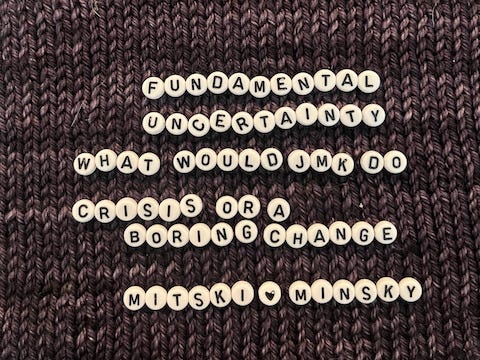
Who is this newsletter for? People who may feel alienated by economics, and hopefully people who also enjoy economic content, business news, and more. People like my parents, who like Paul Krugman and watch MSNBC, and want to know whether it’s ever possible for the deficit to be too big. Wine moms1 with ‘in this bouse’ signs out front. People who don’t know why the DoE’s LPO2 is amazing, and people that do. People who listen to Odd Lots and read Matt Levine’s Money Stuff and roll their eyes at micro and macro 101 assumptions about perfect competition, efficient markets, and more. People who read A.S. Hamrah’s film criticism, and people who read “The Number Ones” (both the pop and the alternative versions) by Tom Breihan3. People who like astrology and tasteful witchy aesthetics, and people with dirt-bag tendencies who like “It’s Always Sunny in Philadelphia”. People who think the question ‘Is it a crisis or a boring change?” is a good litmus for assessing events, current or otherwise. And maybe you, too!
How much: a post a week, 1000 words (give or take). To start, anyway! Cost: free. As my husband’s grandfather used to say, it’s worth exactly what it costs.
With any luck, some of this appeals to you. I’d love for you to read what I’ve got to share, and hope you learn something from it, and maybe even have some fun in the process. Here goes!
Wine moms may, in fact, drink zero wine, or have zero children. I think of it as a state of mind.
DoE = Department of Energy and LPO = Loan Programs Office.
Needless to say, this newsletter reflects my opinions alone, so please don’t bug Joe and/or Tracy, Matt Levine, A.S. Hamrah, or Tom Breihan if you think I’m annoying.
This is a gap in the market in which I’m sure you’ll find a few of us who want to have a way of thinking translated into something digestible. Great idea.